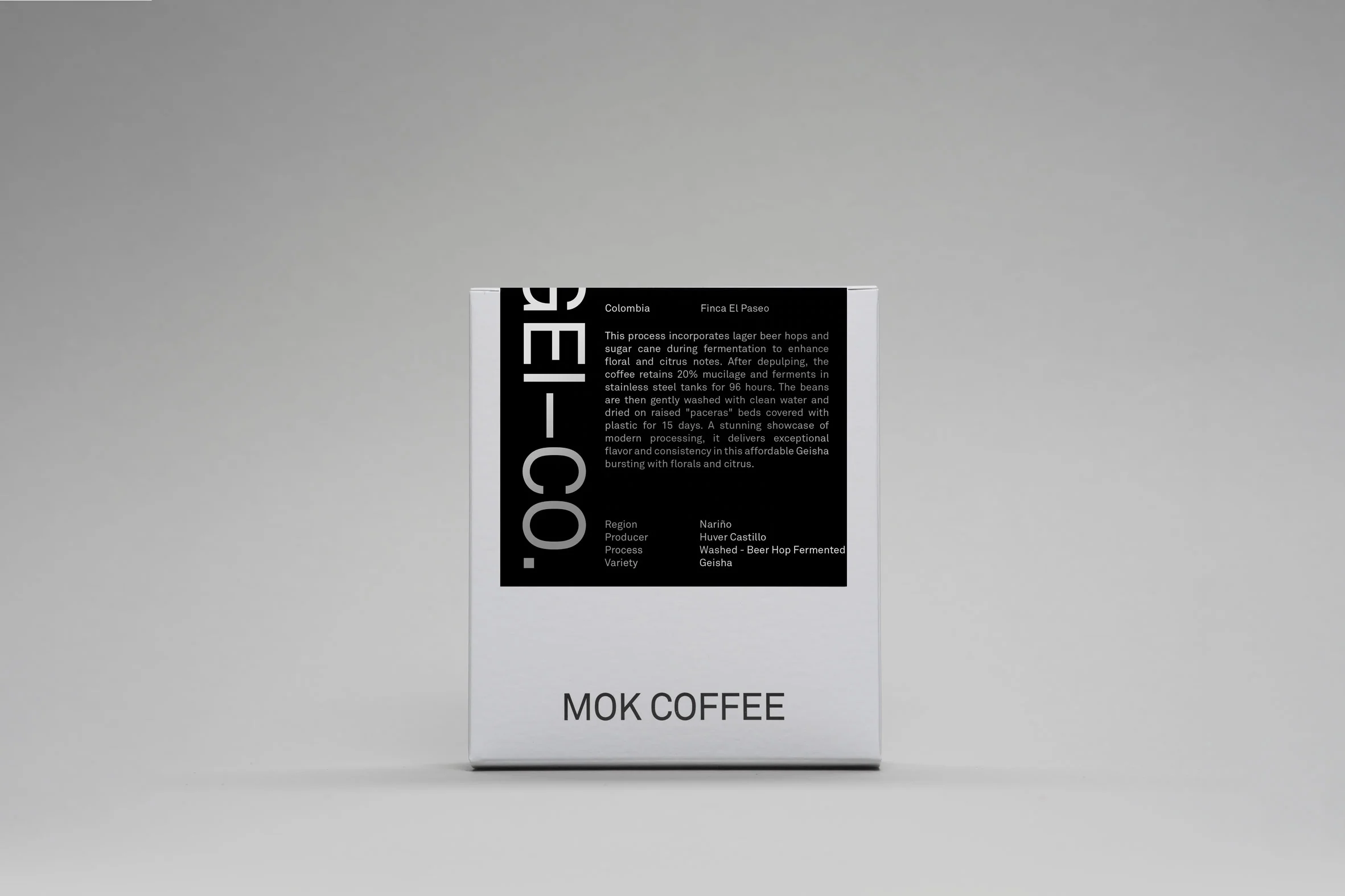
Colombia, Finca El Paseo, Geisha, Washed - Beer Hop Fermented
Huver Castillo is a young, second-generation coffee producer from Buesaco, South Colombia. Together with his father he runs El Paseo, a farm at 1680 - 1800 masl almost fully dedicated to coffee cultivation. Castillo spent the past ten years working on standardized processing methods as well as innovative processing methods to improve the quality of their coffee, after harvest. This particular lot belongs to that second category and the fresh, handpicked cherries immediately go through a depulper which removes about 20 % of all mucilage. Beans, with parchment and some mucilage left on are then moved to closed inox tanks to ferment for 96 hours with a yeast mixture of lager beer hops and sugar cane at a ratio of 5 ml per kg. Anaerobic fermentation allows the sugars in the coffee to turn into acids and so enhance the complexity of the coffee profile. The process is controlled through the monitoring of temperature, which must be stable, a decreasing pH and a decreasing Brix degree. When the fermentation is considered ready, the beans are washed in channels to remove the remaining mucilage and to separate floaters. Parchment is then dried on raised beds covered in plastics for 12 to 15 days until the desired humidity is reached and stored in a warehouse in Pasto to rest until the coffee is ready for the dry mill.
This coffee is sourced through our importing partner Top of the Crop.
Original: $26.00
-70%$26.00
$7.80Colombia, Finca El Paseo, Geisha, Washed - Beer Hop Fermented
Huver Castillo is a young, second-generation coffee producer from Buesaco, South Colombia. Together with his father he runs El Paseo, a farm at 1680 - 1800 masl almost fully dedicated to coffee cultivation. Castillo spent the past ten years working on standardized processing methods as well as innovative processing methods to improve the quality of their coffee, after harvest. This particular lot belongs to that second category and the fresh, handpicked cherries immediately go through a depulper which removes about 20 % of all mucilage. Beans, with parchment and some mucilage left on are then moved to closed inox tanks to ferment for 96 hours with a yeast mixture of lager beer hops and sugar cane at a ratio of 5 ml per kg. Anaerobic fermentation allows the sugars in the coffee to turn into acids and so enhance the complexity of the coffee profile. The process is controlled through the monitoring of temperature, which must be stable, a decreasing pH and a decreasing Brix degree. When the fermentation is considered ready, the beans are washed in channels to remove the remaining mucilage and to separate floaters. Parchment is then dried on raised beds covered in plastics for 12 to 15 days until the desired humidity is reached and stored in a warehouse in Pasto to rest until the coffee is ready for the dry mill.
This coffee is sourced through our importing partner Top of the Crop.
Product Information
Product Information
Shipping & Returns
Shipping & Returns
Description
Huver Castillo is a young, second-generation coffee producer from Buesaco, South Colombia. Together with his father he runs El Paseo, a farm at 1680 - 1800 masl almost fully dedicated to coffee cultivation. Castillo spent the past ten years working on standardized processing methods as well as innovative processing methods to improve the quality of their coffee, after harvest. This particular lot belongs to that second category and the fresh, handpicked cherries immediately go through a depulper which removes about 20 % of all mucilage. Beans, with parchment and some mucilage left on are then moved to closed inox tanks to ferment for 96 hours with a yeast mixture of lager beer hops and sugar cane at a ratio of 5 ml per kg. Anaerobic fermentation allows the sugars in the coffee to turn into acids and so enhance the complexity of the coffee profile. The process is controlled through the monitoring of temperature, which must be stable, a decreasing pH and a decreasing Brix degree. When the fermentation is considered ready, the beans are washed in channels to remove the remaining mucilage and to separate floaters. Parchment is then dried on raised beds covered in plastics for 12 to 15 days until the desired humidity is reached and stored in a warehouse in Pasto to rest until the coffee is ready for the dry mill.
This coffee is sourced through our importing partner Top of the Crop.